
Preparation Problems#
Complete all preparation problems before class time on the scheduled date.
Week 15#
Day 15A: Monday, April 29th
No prep problem assigned for today.
Day 15B: Wednesday, May 1st
No prep problem assigned for today.
Day 15C: Friday, May 3rd
No prep problem assigned for today.
Week 14#
Day 14A: Monday, April 22nd
No prep problem for today.
Day 14B: Wednesday, April 24th
I3 Use substitution rule to calculate the following integral:
Day 14C: Friday, April 26th
I4 Use substitution rule to calculate the following integral:
Week 13#
Day 13A: Monday, April 15th
IC1 Find the particular antiderivative for \(f''(x)=6x+5\) given initial conditions \(f(0)=6\) and \(f(1)=2\).
Day 13B: Wednesday, April 17th
Organize and bring all of your old checkpoint exams with you to class. These will be checked at the beginning of class when you sign in on the attendance sheet.
Day 13C: Friday, April 19th
A rectangular garden is to be built with \(\$900\), so that it is enclosed:
on three sides by a fence costing \(\$20\) per meter and
on one side by a fence costing \(\$10\) per meter.
Find the dimensions of the garden that maximize the area of the garden. Make sure to use units in your final answer. Use a derivative test to justify your answer.
Week 12#
Day 12A: Monday, April 8th
No preparation problem for today.
Day 12B: Wednesday, April 10th
DG5 Use the graph of \(f'(x)\) given below to answer the following questions about function \(f\).
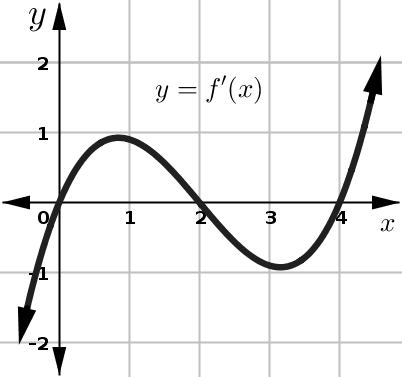
Find the intervals of increase / decrease for \(f\). (Include a sign chart as part of your work.)
Find the critical numbers of \(f\).
Classify the critical numbers of \(f\) as either local maximum, minimum, or neither.
Day 12C: Friday, April 12th
I1 Calculate the following indefinite integrals:
\(\displaystyle \int \dfrac{5}{x^4} \; dx\)
\(\displaystyle \int \left( 4x^3 +8x-7 \right) \; dx\)
Week 11#
Day 11A: Monday, April 1st
No prep problem for today.
Day 11B: Wednesday, April 3rd
O4 Find the maximum value of \(Q=2xy\) provided \(x+y=3\).
Day 11C: Friday, April 5th
O5 You want to plant a rectangular garden along one side of a house, with a fence on the other three sides.
Find the dimensions of the largest garden that can be enclosed using 100 feet of fencing.
Week 10#
Day 10A: Monday, March 25th
DG3 Draw the graph of a function that satisfies all of the following conditions:
concave up on the interval \((-\infty, 3)\)
concave down on the interval \((3,\infty)\)
inflection point at \(x=3\)
Day 10B: Wednesday, March 27th
Write down the sign charts that we did for \(f'\) in examples 2, 3 and 4 of your DG2 notes.
Day 10C: Friday, March 29th
O2: Function \(f\) has critical numbers \(x=0\) and \(x=-4\). Use its second derivative given below to classify these critical numbers.
Week 9#
Day 9A: Monday, March 18th
Spring Break - No prep problem for today.
Day 9B: Wednesday, March 20th
Spring Break - No prep problem for today.
Day 9C: Friday, March 22nd
Spring Break - No prep problem for today.
Week 8#
Day 8A: Monday, March 11th
No preparation problem assigned for today.
Day 8B: Wednesday, March 13th
Draw an example of a function \(y=f(x)\) that satisfies the following properties:
\(f\) is increasing on the intervals \((-\infty, 1)\) and \((4,\infty)\)
\(f\) is decreasing on the interval \((1,4)\)
\(f\) has a local maximum at \(x=1\) and is nondifferentiable there
\(f\) has a local minimum at \(x=4\) and \(f'(4)=0\) there.
Day 8C: Friday, March 15th
Determine the intervals of increase / decrease for a function \(f\) that has first derivative below. Use a sign chart as part of your work.
Week 7#
Day 7A: Monday, March 4th
No preparation problem assigned for today.
Day 7B: Wednesday, March 6th
Use properties of the logarithmic function to rewrite each of the following functions:
\(f(x)=\ln \left( (x+1)^2\cdot (2x+3)^7 \right)\)
\(g(x)=\ln \left( \dfrac{(x+1)^2}{(2x+3)^7} \right)\)
Day 7C: Friday, March 8th
Bring your organized lecture notes and old checkpoint exams with you to class.
Week 6#
Day 6A: Monday, February 26th
Write the function \(h(x)=(6x^2-4x+1)^5\) as a composition of two simpler functions.
Use the general power rule to calculate \(h'(x)\). Show the \([ \cdot ]'\) step in your work.
Day 6B: Wednesday, February 28th
Write the function \(h(x)=6e^{4x^3-2x+6}\) as a composition of two simpler functions.
Use the general exponential rule to calculate \(h'(x)\). Show the \([ \cdot ]'\) step in your work.
Day 6C: Friday, March 1st
Use implicit differentiation to find the derivative \(\dfrac{dy}{dx}\) for the equation \(x^4+y^4 = 1\).
Week 5#
Day 5A: Monday, February 19th
No preparation problem for today.
Day 5B: Wednesday, February 21st
[D1] Differentiate the following functions:
\(f(x)=x^6\)
\(g(x)=\sqrt[3]{x}\)
\(h(x)=\dfrac{1}{x^3}\)
Day 5C: Friday, February 23rd
[D2 and D3] Differentiate the following functions using the indicated rule. Show the \([ \; \cdot \; ]'\) step in your work.
\(f(x)=(2x^2+5x)\cdot (4x-8)\) Product Rule
\(g(x)= \dfrac{2x^2+5x}{4x-8}\) Quotient Rule
Week 4#
Day 4A: Monday, February 12th
DC2: Calculate the average velocity of a particle moving in straight line over the time interval \([1,3]\) with the following position function. Time is measure in seconds and position is measured in meters.
Day 4B: Wednesday, February 14th
DC3: Use the limit definition of the derivative to differentiate the following function:
Day 4C: Friday, February 16th
DC4: Use the graph of \(y=x^2\) to estimate the following derivatives. Draw the graph of the function and the tangent lines as part of your work.
\(f'(-1)\)
\(f'(0)\)
Week 3#
Day 3A: Monday, February 5th
L6: Determine if the following function is continuous at \(x=3\). Show all limits in your work (with correct limit notation).
Day 3B: Wednesday, February 7th
L7: Calculate the following limit at infinity. Use algebraic methods and correct limit notation in your work.
Day 3C: Friday, February 9th
DC1: Calculate the slope of the secant line to the curve \(y=x^2\) connecting:
The two points \((1,1)\) and \((3,9)\).
The points at \(x=1\) and \(x=4\).
Week 2#
Day 2A: Monday, January 29th
Evaluate the following limit justifying each step with the appropriate limit law:
Refer to the graph from Example 1 for the function \(y=f(x)\).
Day 2B: Wednesday, January 31st
Evaluate the following limit. Show all 3 steps in your work.
Day 2C: Friday, February 2nd
Evaluate the following limit. Show all algebraic steps in your work. Be careful to use correct limit notation in your work.
Week 1#
Day 1A: Monday, January 22nd
No preparation problems assigned for today.
Day 1B: Wednesday, January 24th
No preparation problems assigned for today.
Day 1C: Friday, January 26th
Draw an example of a function that satisfies the following three properties:
\(\displaystyle \lim_{x\to 3^+} f(x) =1\)
\(\displaystyle \lim_{x\to 3^-} f(x) =4\)
\(f(3)=2\)